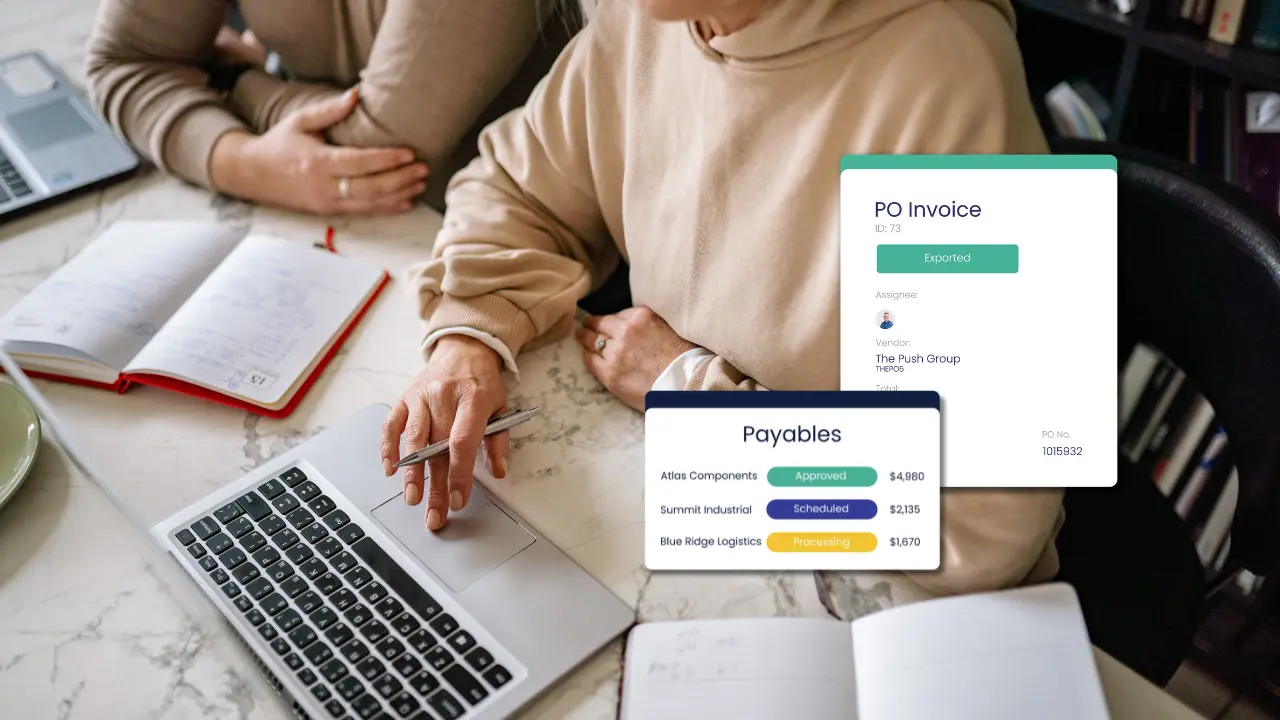
“Our ERP already handles accounts payable.”
It’s a fair point.
Most modern ERPs can receive invoices, route approvals, match purchase orders and post transactions to the ledger.
And for straightforward invoices, that may be enough.
The more useful question is:
Not whether the ERP can process an invoice, but how many invoices reach payment without anyone touching them, and what happens to the ones that don’t.
What's the difference between processing invoices and automating AP?
When everything goes to plan, invoice processing can be relatively simple.
The PO exists. The goods have been received. The invoice matches. The coding is right. The approval is straightforward.
It moves through.
But that isn’t every invoice.
Many invoices arrive without the right information. Deliveries are split. Freight or surcharges don’t match. Credit notes need attention. An invoice belongs to another entity. An approver is away. Supplier details have changed. Tax treatment needs checking.
Then add multiple entities, different invoice channels, duplicate checks and the exceptions AP teams deal with every day.
That’s where the difference starts to show.
Processing is what happens to an invoice when everything is right. Automation is what happens when it isn’t.
In most AP teams, clean invoices make up the bulk of the volume but a minority of the work. The time goes on exceptions: the chasing, re-keying, re-routing and checking that happen around the ERP rather than inside it.
That’s why the measure that matters isn’t whether your ERP can match a purchase order. It’s your touchless rate, the share of invoices that reach payment with no manual intervention, along with the cost and cycle time of everything else.
Why every major ERP has a marketplace full of AP tools
“One platform” rarely means one platform.
Look at the partner marketplace of any major ERP and count the tools built specifically for invoice capture, coding, matching and exceptions. That’s not a failing of the ERP. An ERP is built to be the system of record: the ledger, the vendor master, the payment run. Capturing invoices in every format, resolving the ones that don’t match and chasing approvers who rarely log in is a different job. It’s a sign that AP done well needs specialist depth.
It’s also why ERP vendors increasingly encourage customers to keep the core clean, extending around the ERP rather than customising inside it. Every AP workaround built into the ERP is one more thing to retest at the next upgrade.
When your ERP's AP module is likely to be enough
To be fair to your ERP, it may well be the right answer if:
- Most invoices are PO-backed and arrive structured or as e-invoices
- You run one entity, or a few that share the same rules
- Volumes are steady and your supplier base is stable
- Your approvers already work in the ERP every day
- Exceptions are rare enough that handling them manually isn’t a cost line
When it's worth looking at specialist AP automation
The case for a specialist layer gets stronger when:
- A meaningful share of spend is non-PO, or invoices arrive as PDFs, scans and email attachments
- You operate multiple entities, sites or ERPs, often after acquisitions
- Approvers sit outside finance and rarely open the ERP
- AP headcount grows every time invoice volume does
- Exceptions are managed in spreadsheets and inboxes rather than in a workflow
- Duplicate payments, supplier bank-detail changes or payment redirection fraud are a control concern (see Bank Verification)
- You report under the Payment Times Reporting Scheme
If you mostly recognise the first list, your ERP may be enough. If you recognise the second, the gap is probably costing more than it appears.
In Australia and New Zealand, slow payments are now visible
Under the Payment Times Reporting Scheme, how quickly large businesses pay their small business suppliers is a matter of public record. Since the 2024 reforms, the slowest payers can be required to publish that status. And “we were waiting on an approval” has never once been accepted as an explanation by a supplier who’s carrying your cash flow for you.
E-invoicing is heading the same way. Commonwealth agencies already commit to paying e-invoices within five days. In New Zealand, larger government agencies have had to send and receive e-invoices since 1 January 2026, with large suppliers following in 2027.
But an e-invoice only gets paid in days if what happens after it arrives is automated too. Structured data doesn’t fix a missing goods receipt or an approver on leave.
Slow AP is no longer just an internal efficiency problem. It’s a supplier relationship problem, a compliance problem, and increasingly a reputational one.
Ask the right people
Procurement and IT will tell you invoicing is a small part of a big platform. They’re not wrong — from where they sit.
Then ask AP. Ask the person chasing a goods receipt (GRN) for the fourth time this week. Ask the finance manager reconciling a supplier statement at 7pm. Ask whoever owns month-end close.
They’ll give you a very precise answer about how “sufficient” the ERP’s invoicing module really is.
Where RapidP2P fits
At Efficiency Leaders, procure-to-pay isn’t a module we added to a ledger. It’s the whole focus of what we build.
RapidP2P automates the accounts payable process end to end — capture, coding, matching, approval and duplicate checks. The clean invoices flow straight through. And the difficult exceptions, the non-PO spend, the multi-entity complexity, the matching that doesn’t resolve on the first pass — are handled inside the same process, rather than being handed back to your team as a spreadsheet and a problem.
It also sends and receives e-invoices over Peppol, the global e-invoicing network, for organisations across Australia and New Zealand, so structured invoices flow straight into the same matching and approval workflow and through to your ERP.
It works alongside your ERP, not instead of it. Your system of record stays exactly where it is. We handle the part that takes the most work.
The results show up in the numbers. Twin Towns, which runs TechnologyOne, cut invoice processing time by 81% and processing costs by 80% across more than 150,000 invoices a year. Sonic Healthcare reduced manual AP effort by up to 90% across 14 entities on Microsoft Dynamics. And the Royal Flying Doctor Service grew from 1,000 to more than 4,000 invoices a month without expanding its team, while approval times fell from two weeks to one day.
If you’re weighing up your ERP’s AP module, we’re happy to give you an honest view. In a complimentary 30-minute AP assessment, we’ll look at where your exceptions sit today and what your ERP would handle on its own. If your ERP is enough, we’ll tell you.
Frequently asked questions
What's the difference between invoice processing and AP automation?
Invoice processing is what happens to an invoice when everything is right: the PO exists, the goods have been received, the invoice matches and the approval is straightforward. AP automation is what happens when it isn’t. It handles the exceptions, such as missing information, split deliveries, mismatched freight or surcharges, credit notes and changed supplier details, without sending the work back to your team.
Can my ERP's AP module handle accounts payable on its own?
It may well be enough if most invoices are PO-backed and arrive structured or as e-invoices, you run one entity or a few with the same rules, volumes are steady and your approvers already work in the ERP. The gap shows with exceptions: missing information, split deliveries, freight or surcharges that don’t match, credit notes, invoices for another entity, approvers who are away and changed supplier details.
What's the best measure of how much AP my ERP is automating?
Your touchless rate: the share of invoices that reach payment with no manual intervention, along with the cost and cycle time of everything else.
Why do ERP marketplaces have so many AP add-ons?
An ERP is built to be the system of record: the ledger, the vendor master and the payment run. Capturing invoices in every format, resolving the ones that don’t match and chasing approvers who rarely log in is a different job. The number of specialist invoice capture, coding, matching and exception tools in every major ERP marketplace is a sign that AP done well needs specialist depth.
Does specialist AP automation replace my ERP?
No. RapidP2P works alongside your ERP. It handles capture, coding, matching, approval and duplicate checks, then passes transactions through to your ERP, which stays your system of record.
Will adding AP automation make ERP upgrades harder?
Not if it sits alongside the ERP. ERP vendors increasingly encourage customers to keep the core clean and extend around the ERP rather than customising inside it. Every AP workaround built into the ERP is one more thing to retest at the next upgrade, whereas a specialist layer like RapidP2P passes transactions through to your ERP without changing it.
Does Peppol e-invoicing remove the need for AP automation?
No. E-invoicing gives you structured invoice data, but an e-invoice only gets paid in days if what happens after it arrives is automated too. Structured data doesn’t fix a missing goods receipt or an approver on leave. RapidP2P sends and receives e-invoices over Peppol and runs them through the same matching and approval workflow as every other invoice.
What is the Payment Times Reporting Scheme and why does it matter for AP?
Under Australia’s Payment Times Reporting Scheme, how quickly large businesses pay their small business suppliers is a matter of public record. Since the 2024 reforms, the slowest payers can be required to publish that status. That makes slow AP a supplier relationship, compliance and reputational problem, not just an internal efficiency one.
Which ERPs does RapidP2P work with?
RapidP2P integrates with ERPs including TechnologyOne, Civica Authority, Jobpac, Microsoft Dynamics, Oracle NetSuite and SAP Business One. See all ERP integrations.