Healthcare
Accounts Payable Automation for Healthcare and Aged Care
Reduce invoice delays across your care locations
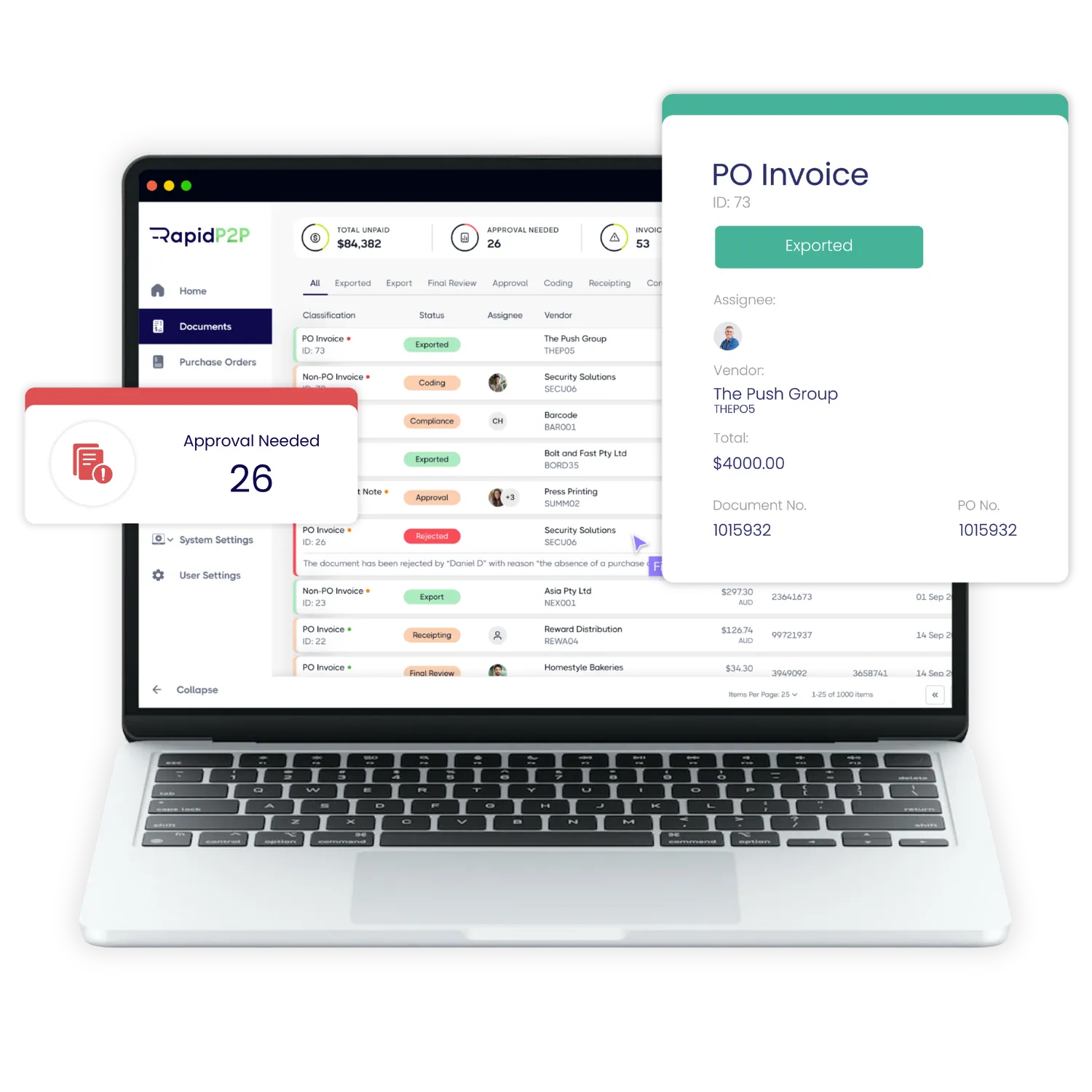
RapidP2P automates vendor invoice processing and approvals across healthcare, aged care and disability services. Help vendors get paid on time, give finance clearer visibility over outstanding costs and reduce approval chasing across facilities and teams.
Customer stories
See How Cerebral Palsy Alliance Transformed Its Accounts Payable Process
$240M annual revenue
Built for healthcare finance
Keep vendor invoices moving across facilities and services
Reduce delays before vendor payments
Simplify clinical supply invoice processing
See costs across facilities and services
Keep approvals accountable across care locations
Apply financial delegations consistently across hospitals, clinics, aged care homes and community services. Maintain a traceable record of invoice checks, approvals and changes.
How RapidP2P Suite helps
Modular products. Connected workflows. Governed from supplier setup to payment.
Accounts Payable Automation
Procurement
Vendor Portal
Vendor Onboarding
eInvoicing
Supporting Peppol eInvoicing in Healthcare
Digital invoices within your healthcare AP workflow
Reduce manual invoice handling and improve data quality while keeping your approval requirements and ERP-connected processes in place.
Strengthen controls over vendor details and payments
Independent bank verification
Bank-detail change control
Early fraud detection
Less manual checking
Seamless Integration with ERPs Used by Healthcare Organisations
Healthcare customer stories
Healthcare Finance Teams, in Their Own Words
Sonic Healthcare
Up to 90% fewer keystrokes
Royal Flying Doctor Service
From 2 weeks to 1 day: faster invoice approvals.
St John Ambulance
5 min invoice processing time, reduce from hours.
Low-commitment next step
Not ready for a full demo?
Start with a healthcare AP assessment
Healthcare AP Automation FAQs
How can healthcare and aged care teams reduce manual invoice processing?
AP automation reduces the work involved in receiving, checking and routing supplier invoices. RapidP2P connects capture, validation and approvals, helping finance teams spend less time entering data and following up. Managers across facilities can work within a consistent process, with clearer visibility over invoices and exceptions.
Can invoice coding and approvals reflect our healthcare facilities, departments and cost centres?
Yes. RapidP2P can be set up to mirror however your health service is arranged — by facility, department, cost centre, or right down to individual sites if that’s how you manage responsibility. Coding and approval rules follow that same structure, so local managers keep ownership of their invoices while central finance gets one consistent view across every facility.
Can AP automation integrate with our existing healthcare ERP?
RapidP2P is designed to work alongside dozens of ERP systems including TechnologyOne, Microsoft Dynamics and Oracle NetSuite, to name a few. It adds supplier-invoice workflows rather than replacing the core finance system. Your ERP version, required data mappings and selected modules are confirmed when the integration is scoped.
How can we simplify invoice approvals for healthcare managers?
Give managers a defined approval task instead of asking them to reconstruct email chains. RapidP2P supports invoice routing, notifications, escalations and task reassignment. Managers make the decisions required by your policy, while finance can see where invoices are waiting and follow up on the outstanding action
Can AP automation improve month-end visibility in healthcare?
Yes. RapidP2P helps finance review invoices already received, including those awaiting approval or exception resolution. This gives Financial Controllers more information about supplier costs not yet posted to the ERP. It supports month-end investigation and accrual preparation; finance remains responsible for the accounting decisions.
How does AP automation support audit readiness in healthcare?
RapidP2P records invoice history, approval activity and exceptions, helping finance trace how transactions were handled. Agreed workflows support consistent processing across facilities. These records make evidence easier to review during internal or external audits, rather than relying on separate email chains to reconstruct decisions.
What results have healthcare organisations achieved with RapidP2P?
Sonic Healthcare reported up to 90% fewer keystrokes through automated invoice data capture. Its implementation also introduced centralised invoice handling, status tracking, escalations and audit history. These results show what changed for Sonic Healthcare; outcomes for another provider depend on its starting processes and implementation scope.
What should healthcare organisations check before choosing AP automation software?
Test ERP compatibility, approval controls, duplicate checks, exception handling and the experience for managers across facilities. Ask how supplier information is verified and request current security, hosting, access-control and support documentation. Use your own invoice scenarios to assess suitability, rather than relying on a healthcare label alone.
How can we plan an AP automation rollout across multiple healthcare facilities?
Map the facilities, entities, coding requirements and local approval responsibilities before agreeing the rollout. Allow time for ERP testing, training and checking exceptions as well as routine invoices. Agree the implementation scope and sequence around these requirements, your priorities and the capacity of your finance and IT teams.
What security and access controls should healthcare finance teams check?
Confirm who can view invoices, approve transactions and update supplier information, and how those permissions will be managed. Review the provider’s current security, hosting, data-access and support documentation with your finance and IT teams. Assess the proposed controls against your requirements rather than relying on a healthcare label alone.