
Rules stated as at 25 November 2026.
Short answer: for most Australian and New Zealand organisations, no. No law in either country requires businesses to send or receive e-invoices. The obligations that exist sit with government buyers, and they are tightening now.
In Australia, federal departments and agencies must be able to process e-invoices automatically and send them by December 2026. From 1 January 2027, they must pay every supplier invoice within 10 business days, however it arrives. In New Zealand, from the same date, larger government agencies must require large suppliers to send e-invoices.
That makes public sector finance teams the most urgent audience for this article. But the question it answers matters to any finance or accounts payable (AP) team that receives invoices. Government is setting the standard for how invoices will move between organisations, and the operational lessons apply well beyond Canberra and Wellington.
What counts as an e-invoice?
An e-invoice is invoice data exchanged directly between the supplier’s and the buyer’s systems over the Peppol network, the international network Australia and New Zealand adopted as their joint standard. A PDF attached to an email is not an e-invoice, even though it is electronic. The difference matters: a PDF still has to be read, keyed or extracted before anyone can act on it, while an e-invoice arrives as structured data a system can validate on arrival.
What are the e-invoicing rules in Australia and New Zealand?
The rules are set through government procurement and payment policy, not legislation, and they apply to government buyers. Some are firm requirements; others are targets. Reading them correctly matters, because much of the commentary in the market blurs the two.
| Date | What applies | Who it applies to | Status |
|---|---|---|---|
| 1 July 2022 | Must be able to receive Peppol e-invoices | Australian non-corporate Commonwealth entities (NCEs) | Requirement, in force |
| 1 January 2026 | Must be able to receive (and, where relevant, send) e-invoices through primary AP and AR systems | NZ agencies handling more than 2,000 domestic trade invoices a year | Requirement, in force |
| 1 July 2026 | E-invoices to reach 30% of invoices received | Australian NCEs | Target |
| December 2026 | Automated processing of received e-invoices, and the ability to send them | Australian NCEs | Requirement |
| 1 January 2027 | Pay every procurement invoice within 10 business days, whatever its format | Australian NCEs | Requirement |
| 1 January 2027 | Require large suppliers to send e-invoices | NZ agencies above the 2,000-invoice threshold | Requirement |
Sources: ATO, eInvoicing for government; ATO, eInvoicing by default guidance; Department of Finance, Updated Commonwealth Supplier Payment Terms; NZ Government Procurement Rule 44.
Australia: e-invoicing by default for federal agencies
The Australian Government introduced its eInvoicing by default policy in March 2025. It builds on the 2022 requirement for federal agencies to be able to receive e-invoices, and makes e-invoicing their standard channel for procurement. The ATO, as the Australian Peppol Authority, asks agencies to build it into contracts as templates are updated, to avoid discouraging suppliers from using it, and to report progress quarterly.
The December 2026 requirement is the operationally demanding one. According to the ATO’s guidance, received e-invoice data should flow directly into business systems, rather than being converted back into PDFs or emails for manual handling. Larger agencies and shared service providers are expected to go further, with business rules, automated approvals, matching and exception handling.
Australia: one payment clock from 1 January 2027
Until 31 December 2026, federal agencies must pay agreed Peppol e-invoices within 5 calendar days and other invoices within 20 calendar days. From 1 January 2027, the Department of Finance’s updated Supplier Pay On-Time or Pay Interest Policy (RMG 417) replaces both with a single maximum of 10 business days for all invoices. The clock starts once the agency has accepted delivery and holds a correctly rendered invoice. Late payment can mean owing eligible suppliers interest.
The practical effect is that the e-invoice stops being a fast lane and becomes the norm, while PDF and email invoices now run on a clock roughly a week shorter than before.
New Zealand: the obligation reaches suppliers
New Zealand’s approach goes one step further. Under Rule 44 of the Government Procurement Rules, agencies that receive more than 2,000 domestic trade invoices a year have had to be e-invoice capable since 1 January 2026. From 1 January 2027, those agencies must require large suppliers to send e-invoices. A large supplier is one whose revenue, with its subsidiaries, exceeded NZ$33 million in each of the two preceding accounting periods.
This is still a procurement rule rather than a law. But for a large supplier that wants to keep selling to government, the practical difference is small.
Who is affected, and how much?
The direct obligations cover a narrow group. The practical pressure reaches much further, because every organisation that buys from or sells to government sits on one side of the same transaction.
| Organisation | Formal obligation today | What to expect |
|---|---|---|
| Australian federal departments and agencies (NCEs) | Yes: receive, automate, send, report, and pay within 10 business days from 1 January 2027 | The most urgent group. December 2026 is weeks away |
| Corporate Commonwealth entities | No, but encouraged to adopt the ATO guidance and the payment policy | Likely to follow federal practice |
| State and territory agencies | Set by each jurisdiction, with no national rule | Uneven. NSW, SA and the ACT can already receive e-invoices; others are at different stages |
| Local councils | No requirement in Australia | Voluntary adoption is growing, often driven by efficiency and fraud control rather than compliance |
| NZ government agencies | Yes, above 2,000 domestic trade invoices a year | Capability in place since January 2026; supplier requirement from January 2027 |
| Suppliers to government | Australia: no. NZ: yes for large suppliers from 1 January 2027 | Australian agencies are writing e-invoicing into contracts as they renew |
| Private-sector buyers | No | No mandate, but a growing share of suppliers can already send e-invoices |
For councils and state agencies, the absence of a mandate is not a reason to wait. The ATO reports more than 400,000 businesses already registered on the Peppol network, which means many of a council’s suppliers can likely send e-invoices today. The question is whether the receiving organisation can do anything useful with them when they arrive.
For private-sector finance teams, the federal rules are best read as a preview. They set out, in unusual detail, what a government regards as a well-run AP function: data that flows straight into business systems, validation on arrival, and approvals fast enough to pay on a short clock.
Why it matters beyond compliance
For federal agencies, receiving an e-invoice was the 2022 test. The harder question is what happens after the invoice lands. Four issues decide whether e-invoicing delivers value or simply moves the bottleneck.
The slowest step sets the pace. A 10-business-day payment clock leaves little room for an invoice to wait in a shared inbox or an approver’s queue. In most AP functions, the delay is not in receiving the invoice; it is in validation, matching and approval. Faster delivery only helps if those steps keep up.
Most invoices will still not be e-invoices. Even an agency that meets the 30% target still receives most of its invoices as PDFs, emails or paper. Running e-invoices through one process and everything else through another doubles the work of control and reporting. The goal is one workflow for every invoice, whatever its format.
Structured data does not replace controls. Peppol takes email out of invoice delivery, which removes one route for fraud. It does not stop a compromised supplier system from sending a valid e-invoice with altered bank details. The ATO, citing National Anti-Scam Centre figures, reports more than A$166 million lost to payment redirection and false billing scams in 2025. Bank-detail validation, approval rules and an audit trail remain essential.
Data quality determines the payoff. An e-invoice is only as useful as the purchase order number, buyer reference and coding it carries. Under the Australian policy, the payment clock starts only once an invoice is correctly rendered. Incomplete data does not just slow processing; it delays the point at which the obligation to pay begins, and creates friction with suppliers.
How ready is your AP function? A practical check
The test for each area is simple: could you show it working today? Any “no” is a gap. For federal agencies, gaps need closing before December 2026, or before 1 January 2027 where they affect the payment clock. For everyone else, the same list is a sound basis for a business case.
| Area | What good looks like | Usually owned by |
|---|---|---|
| Receiving | E-invoices land as data, with no PDF or email step in between | AP Manager |
| One workflow | PDF, email and paper invoices follow the same process and controls as e-invoices | AP Manager |
| Validation and posting | ABN, PO, totals, GST, duplicate and bank-detail checks run on arrival; validated data posts to the ERP with coding intact | AP Manager; Head of Applications |
| Approvals and cycle time | Every invoice can be approved and paid inside the required terms, including across delegations and sites | Financial Controller |
| Supplier onboarding | Top suppliers by volume invited to switch; invoicing clauses updated at renewal | Procurement and AP |
| Sending and reporting | E-invoices can be sent to Peppol-registered customers; any required reporting comes from the system, not a spreadsheet | Accounts receivable; Financial Controller |
Is your ERP’s e-invoicing module enough?
Often, yes. Many ERPs and accounting platforms now receive Peppol e-invoices. The ATO’s guidance draws the line at volume and complexity: smaller organisations can rely on standard tools for basic validation and matching, while larger ones are expected to add business rules, automated approvals and exception handling.
In our experience, a dedicated AP layer alongside the ERP tends to earn its place when several of these apply: high or growing invoice volumes across many sites; multiple entities or a shared service model; approval delegations spanning sites and cost centres; a mixed inbox of e-invoices, PDFs and non-PO invoices; and frequent exceptions such as price variances, duplicates or bank-detail changes. If few of these apply, the ERP’s own module may well be the right answer.
Where Efficiency Leaders fits
The sections above apply whichever software you use. This section explains our own offer.
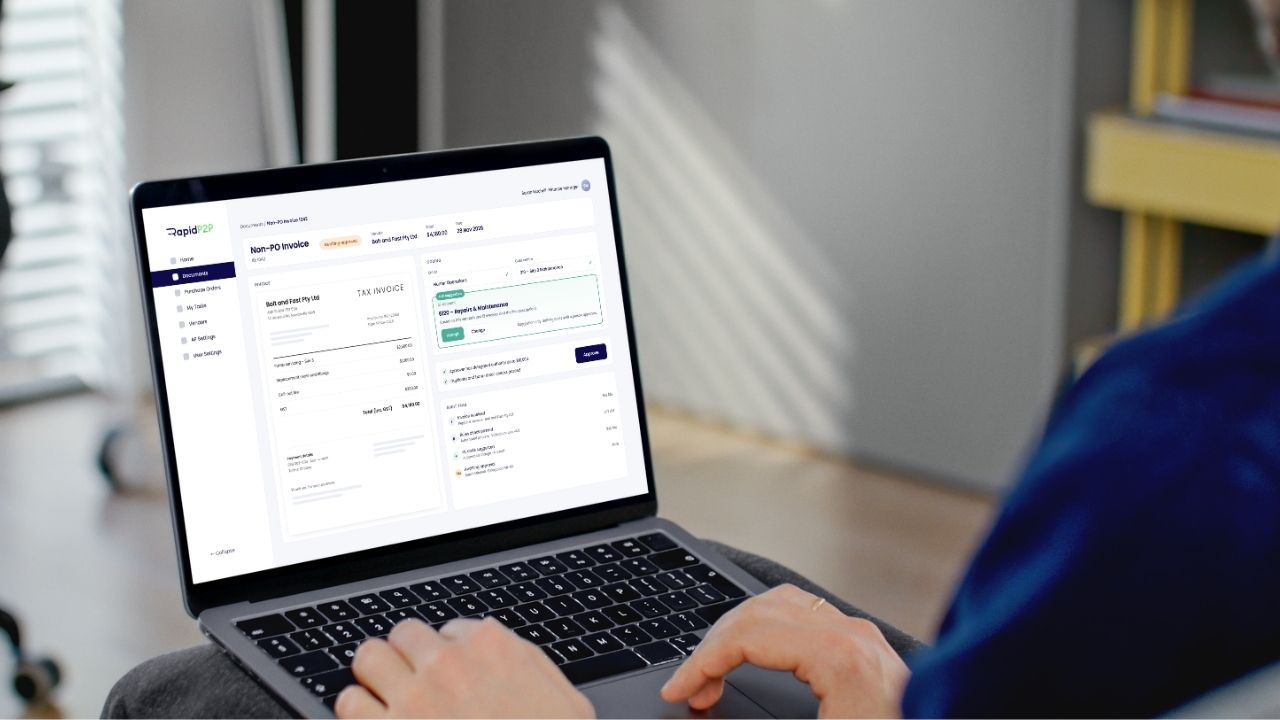
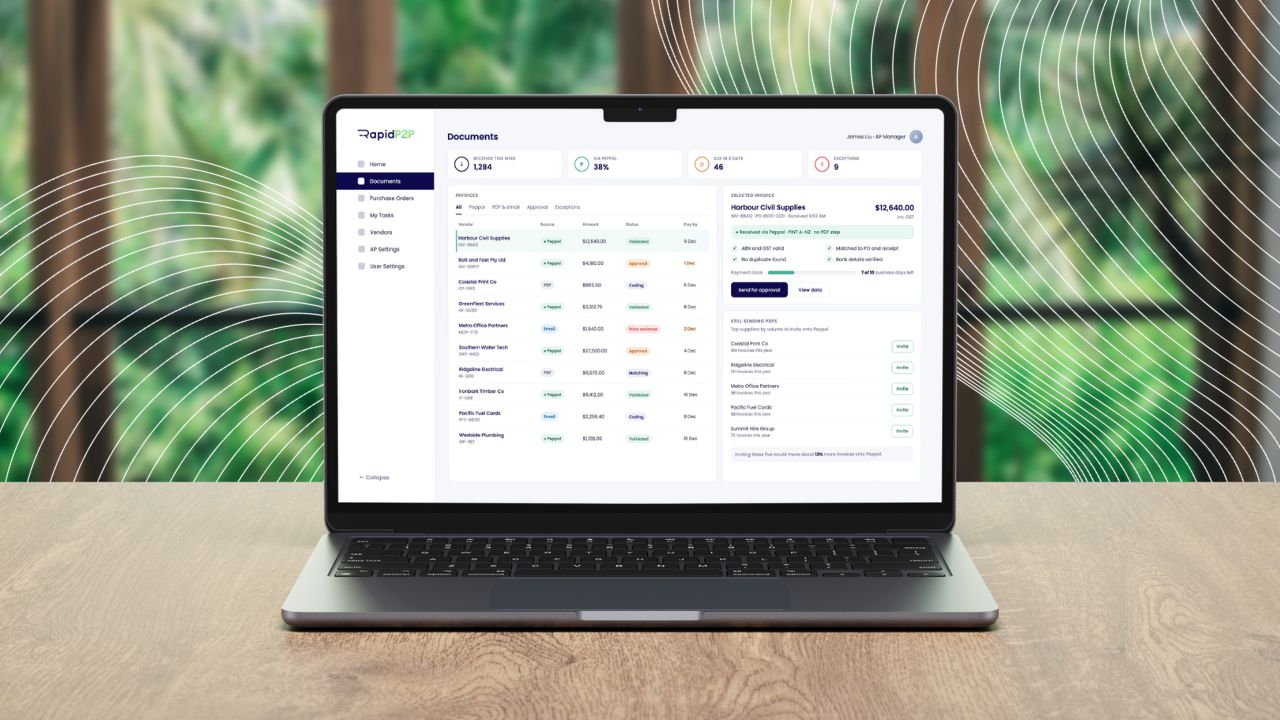
In RapidP2P, Efficiency Leaders’ AP automation platform, Peppol e-invoicing is included as standard. There is no separate module to buy and no access point to run: RapidP2P receives e-invoices through an ATO-accredited access point partner and processes them in the same workflow as PDF and email invoices.
Every invoice, whatever its format, goes through the same steps: validation, PO matching, bank-detail checks, approval routing and posting to your ERP. RapidP2P works with all major ERPs. It also shows which suppliers still send PDFs, so AP and procurement teams know whom to invite onto Peppol next. Typical onboarding takes four to six weeks, depending on the ERP.
To be clear about scope: RapidP2P handles the receiving side. Sending e-invoices, and any quarterly reporting to the ATO, stay with your ERP or billing system.
In our implementations, approval time is usually where days are lost. The Royal Flying Doctor Service, which runs AP for 21 bases, has cut some approvals from up to two weeks to one day, and grown from about 1,000 to more than 4,000 invoices a month with the same team (RFDS case study). See Peppol e-invoicing for accounts payable for more detail.
Check your e-invoicing readiness. Book a 30-minute e-invoicing readiness check, and we will walk through how your invoices move from receipt to ERP posting today and where the manual steps sit. It is useful whether or not you end up working with us. Book your readiness check
Frequently asked questions
Is e-invoicing mandatory for businesses in Australia?
No. As at 25 November 2026, no business-to-business e-invoicing mandate is in force in Australia. The obligations sit with federal agencies, which must receive e-invoices, automate their processing by December 2026 and treat e-invoicing as the default for procurement. Treasury consulted on a business e-invoicing right in 2021–22, but no legislation followed.
Do councils have to use e-invoicing?
No. There is no e-invoicing requirement for Australian local government. Councils that adopt it do so voluntarily, usually to reduce manual processing and strengthen controls over supplier payments.
Is e-invoicing mandatory in New Zealand?
Not for businesses in general. From 1 January 2027, government agencies that handle more than 2,000 domestic trade invoices a year must require large suppliers, those with revenue above NZ$33 million in each of the two preceding accounting periods, to send e-invoices.
Do we need our own Peppol access point?
No. Organisations connect through an ATO-accredited Peppol service provider, which is often built into their ERP, accounting or AP software.
What is PINT A-NZ?
PINT A-NZ is the Australian and New Zealand version of Peppol’s international invoice specification. It defines the data fields and business rules an e-invoice must meet, and has been the mandatory format for service providers since 15 November 2024.
What happens if a federal agency misses the December 2026 deadline?
The ATO’s guidance sets no financial penalty. But agencies report progress to the ATO every quarter, so gaps are visible, and from 1 January 2027 late payment can mean owing eligible suppliers interest. In practice, missing automation shows up as late payments and manual workload.
Sources
- Australian Taxation Office, eInvoicing for government
- Australian Taxation Office, eInvoicing by default guidance, last updated 13 October 2026
- Australian Taxation Office, eInvoicing news and statistics
- Department of Finance, Procurement Policy Note: Updated Commonwealth Supplier Payment Terms
- Department of Finance, RMG 417, effective 1 January 2027 (PDF)
- New Zealand Government Procurement, Rule 44: eInvoicing capability
- The Treasury, Supporting business adoption of eInvoicing (consultation)
- A-NZ Peppol Authorities, A-NZ Peppol BIS 3.0 repository