
When AI enters accounts payable, the auditor’s question stays the same: who approved this invoice, and under what authority? The answer should stay the same too: approval rules that run every time, and a record of each decision. AI can take accounts payable to another level of speed and accuracy. It does that safely only once those rules and records are in place, so the first job is the rules.
Why does this matter now?
Finance teams are being told AI can take over accounts payable. Yet in many organisations, large ones included, the controls AP depends on are surprisingly informal. A regional manager resigns, but the approval matrix still lists them. Invoices keep landing in their old inbox, and a colleague starts approving them “to keep things moving.” Nobody updated the limits, nobody signed off on the cover arrangement, and months later nobody can say who had the authority to approve what. That is an audit problem before any AI arrives. When the rules sit in a spreadsheet or someone’s memory, so does the evidence.
Add AI to that process and you add another source of decisions that nobody can trace. An AI will follow an out-of-date approval matrix just as faithfully as a current one, and it won’t notice when the person it routes to no longer works there. Fix the rules first, and AI has something solid to work inside. In AP, that means clean supplier and bank data, approval authority held in the system, and controls tested before any AI is switched on.
Analysts are saying the same thing. A 2026 Gartner survey of more than 2,000 CIOs and technology executives found that 71% of organisations expect to deploy agentic AI within 12 months, yet only 21% have governance for it in place. Gartner has also reported that organisations with successful AI initiatives invest up to four times more, as a share of revenue, in foundations such as data quality and governance than those with poor outcomes.
Regulators are drawing the same line. ASIC’s 2024 review of AI use by financial services licensees, Beware the gap, found that some were adopting AI faster than they were updating their governance. The Australian Government’s Guidance for AI Adoption, released in October 2025, makes accountability and human control core practices.
What does “rules first” look like in AP?
Four controls carry most of the audit load:
- Approval by delegation. An invoice can only go to someone with authority for that amount, cost centre or project.
- Checks before posting. Coding, PO and receipt matching, duplicate detection and supplier bank-detail checks run before anything reaches the ERP.
- Segregation of duties. The person who sets up a supplier can’t also approve that supplier’s invoices.
- A complete audit trail. Who submitted, checked, changed and approved each invoice, and when.
These are rules. They give the same answer every time, whoever is at the desk and whatever time it is.
Where does AI fit?
Our position at Efficiency Leaders is that you need both, in the right order. The rules are the foundation, and we are good at them. AI can then take you to another level of efficiency and accuracy, as long as you keep the same rules and audit trail. We call it Recommend. Validate. Approve. AI assists and recommends; the platform’s rules-based core validates, and your people approve. By default, a human stays in the loop. AI might suggest a GL code or point to the likely reason a match failed. It does not approve invoices or make payments.
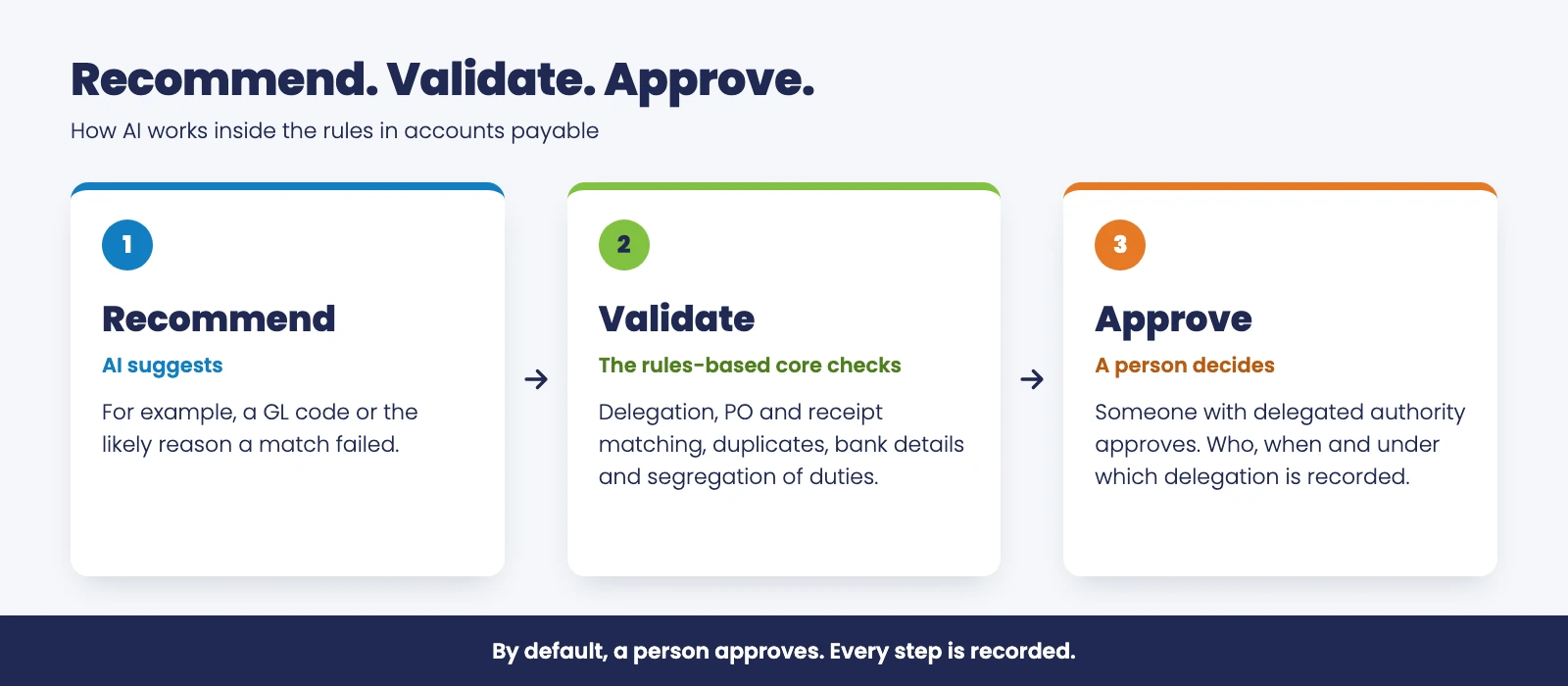
The next generation of our product, RapidP2P, is built on that rules-based core, so every transaction is predictable, repeatable and traceable. It pairs that core with AI assistance, such as suggested GL coding, which you switch on when you are ready. By default, those suggestions wait for a person.
Every change to an invoice is written to an append-only record: what changed, when, and who made the change, whether a named person or a named automated process. The record also shows whether a person approved the invoice, including anyone they approved on behalf of, or whether it was released automatically under a rule you configure. If AI applies a code, the record names it as an automated change.
What do the controls deliver before any AI?
The rules deliver results in their own right, and they are what lets you add AI safely.
- Port of Newcastle (TechnologyOne) halved its AP workload. Ben Reece, Financial Controller, said: “The controls are much stronger, and everyone across the business has said how much easier the process is. It lets us focus more on analysis and adds real value.”
- Royal Flying Doctor Service (TechnologyOne) cut approvals from up to two weeks to one day, across 21 remote bases.
- Moorabool Shire Council (TechnologyOne) freed the equivalent of one full-time role, and went live in six weeks, within budget.
- Lipman (Jobpac) secured $250,000 in social engineering fraud cover at no additional premium, with its insurer recognising the control environment built on RapidP2P and Eftsure bank-account verification as low risk.
Those results came from putting invoices, approvals, coding and supplier checks onto rules that run every time. AI builds on that foundation; it doesn’t replace it.
What should you ask before adding AI to AP?
- For any invoice, can we show who approved it and under which delegation?
- Are our approval rules held in a system, not in people’s heads?
- If an AI tool suggested a code, could we tell the suggestion apart from the person’s decision?
- Is there a named owner for the rules, and a clear process for changing them?
- Can we show when a rule changed, who changed it and who signed it off?
- If an AI suggestion is wrong, are we confident it can’t reach the ledger, and have we tested that?
If any of those answers is “not really”, start there. Get the rules right first, then add AI with confidence.
Next step
Book a complimentary 30-minute AP assessment, and we’ll walk through where your approval evidence sits today.
Frequently asked questions
Can AI approve invoices in accounts payable?
It shouldn’t. Approval is a delegated authority, and auditors need to see which person approved each invoice and under which delegation. AI can help by suggesting GL codes or flagging the likely reason a match failed. Efficiency Leaders calls the approach Recommend. Validate. Approve.: AI recommends, a rules-based core validates, and people with delegated authority approve.
How do I show an auditor who approved an invoice?
Route every invoice by delegation, so it can only reach someone with authority for that amount, cost centre or project. Then keep a record of who submitted, checked, changed and approved it, and when. Email approvals make this hard because the evidence sits in inboxes. AP automation such as RapidP2P keeps the approval trail in one place.
What is a rules-based AP platform?
A rules-based AP platform makes decisions using configured rules, so approval routing, validation and matching follow the same logic every time. That makes it deterministic: the same invoice and the same rules give the same result, and each outcome can be traced. The next generation of RapidP2P is built on a rules-based core.
Should we automate AP rules before adding AI?
Yes. AI suggestions are only as accountable as the approval rules they sit inside. Efficiency Leaders’ customers saw measurable gains from automating invoices, approvals and coding: Port of Newcastle halved its AP workload, and Royal Flying Doctor Service cut approvals from up to two weeks to one day. AI builds on that foundation.
What do auditors look for in invoice approvals?
Auditors look for evidence that each invoice was approved by someone with delegated authority and that duties were segregated. They also check that changes to supplier details and approval rules were controlled, and that a complete record shows who did what and when. When that evidence sits in inboxes or spreadsheets, it is hard to produce.
Does “rules first” apply across procure-to-pay, not just AP?
Yes. The same principle runs from purchase request to payment: spend is approved by delegation, checked against rules and recorded before it is committed. This article focuses on accounts payable because invoice approval is where approval authority, supplier bank details and payment meet. Procurement controls, such as PO approval by delegation, follow the same logic.